Loading...
FREE SHIPPING | 3-YEAR WARRANTY ON ALL MACHINES
Loading...
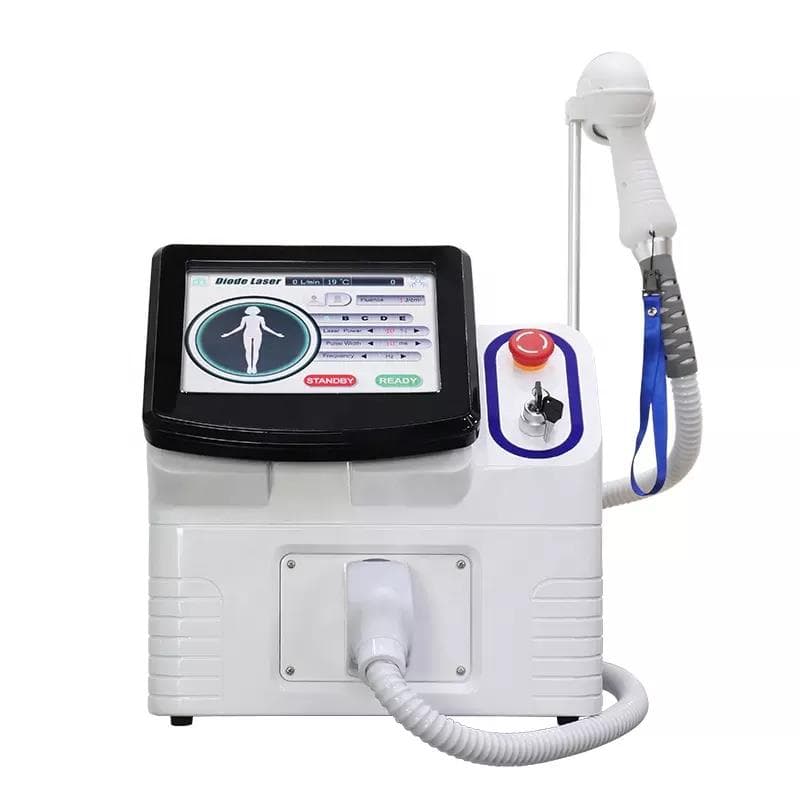
Diode laser is the clinical gold standard for permanent hair reduction. A semiconductor-pumped beam (typically 808nm, often blended with 755nm and 1064nm) is absorbed by melanin in the follicle and converted to heat, disabling the regrowth structures while a contact-cooled tip protects the surface. It is fast, comfortable, and—on the right settings—safe across a wide range of skin tones.
The Science
Diode laser hair removal is built on the principle of selective photothermolysis: a single wavelength is chosen so that it is preferentially absorbed by one target (the chromophore) while sparing surrounding tissue. In hair removal, the chromophore is melanin concentrated in the hair shaft and follicle.
The 808nm diode wavelength penetrates to the depth of the bulge and dermal papilla—the two structures responsible for regrowth—while being deep enough to bypass most of the melanin in the epidermis. Energy absorbed by the pigmented follicle is converted to heat. When that heat reaches roughly 65–70°C and is held for the correct duration, the follicle is thermally disabled.
Modern systems use an in-motion / SHR (Super Hair Removal) technique: lower fluence delivered at high repetition over multiple passes gradually accumulates heat in the follicle to ~45°C, which is far more comfortable than single high-energy pulses and significantly safer on darker skin. Integrated contact cooling (sapphire tip chilled to -5°C) draws heat out of the epidermis at the moment of the pulse, allowing higher follicular energy with minimal surface risk.
Hair only sheds permanently when treated during its active growth (anagen) phase. Because only 20–30% of follicles are in anagen at any time, a full course of 6–10 sessions spaced 4–6 weeks apart is required for complete, lasting reduction.
The Process
Skin type (Fitzpatrick) and hair color are assessed, contraindications screened, and a small test area is treated 24–48h ahead to confirm safe settings.
The area is cleansed and shaved—not waxed or plucked—so the follicle remains intact for the laser to target.
Settings are dialed in for the area and skin tone; the sapphire tip pre-cools the skin to protect the epidermis.
The handpiece is glided over the area in overlapping passes, gradually building follicular heat while the client feels a warm, tolerable sensation.
A cooling gel or aloe is applied; sun avoidance and SPF are advised. Shed hair will fall out over 1–3 weeks.
Treatable Areas
Precise, low-energy work on delicate facial hair for both women and men.
A fast, high-satisfaction area—usually clears in 6–8 sessions.
High-demand area; in-motion mode keeps sensitive skin comfortable.
Large flat areas where big spot sizes deliver excellent speed.
Popular with male clients; dense coarse hair responds very well.
Why Diode
Disables follicles at the source for results no wax, thread, or shave can match.
Large spot sizes and high repetition rates clear large areas in minutes.
In-motion technique plus contact cooling makes it far gentler than IPL or older lasers.
With proper settings (and added 1064nm), diode is safer on tanned and darker skin than IPL.
High client demand, repeatable protocols, and low consumable cost make it a clinic workhorse.
Clinical Evidence
Lasers in Surgery and Medicine · 2006
Reported 70–90% lasting hair reduction after a full multi-session course in suitably selected patients.
Journal of Cosmetic and Laser Therapy · 2013
In-motion delivery achieved comparable efficacy with markedly higher comfort and lower adverse-event rates.
Dermatologic Surgery · 2011
Confirmed favorable safety on darker phototypes when fluence, pulse width and cooling are appropriately set.
Skin Safety
| I | II | III | IV | V | VI | |
|---|---|---|---|---|---|---|
| 808nm Standard | Safe | Safe | Safe | Safe | Caution | Not recommended |
| SHR / In-Motion | Safe | Safe | Safe | Safe | Safe | Caution |
| 1064nm Add-on | Safe | Safe | Safe | Safe | Safe | Safe |
Pure 808nm is best on light-to-medium skin (I–IV). For deeply pigmented skin (V–VI), use SHR/in-motion at conservative fluence or a 1064nm channel, which bypasses epidermal melanin and is the safest choice for dark skin.
Safety
Diode laser is a Class IV device. Wavelength-rated eyewear is mandatory for operator and client. A patch test 24–48 hours before the first session is essential to confirm settings on the client’s skin. Never treat over tattoos, recently tanned skin, or active infection. Track fluence, pulse width and cooling for every session.
✕ Not recommended during pregnancy
For Operators
| Area | Energy | Pulse | Spot | Freq | Cooling | Passes |
|---|---|---|---|---|---|---|
| Face/Lip | 10–16 J/cm² | 10–30ms | 12x20mm | 5–10Hz | Contact -5°C | 3–4 |
| Underarm | 12–20 J/cm² | 20–40ms | 12x20mm | 3–5Hz | Contact -5°C | 2–3 |
| Bikini | 12–18 J/cm² | 20–40ms | 12x20mm | 3–5Hz | Contact -5°C | 2–3 |
| Legs/Arms | 14–24 J/cm² | 30–100ms | 12x30mm | 1–3Hz | Contact -5°C | 2–3 |
| Back | 16–28 J/cm² | 30–100ms | 12x30mm | 1–3Hz | Contact -5°C | 2–3 |
Choosing the right modality comes down to skin tone, throughput and comfort. Here is how diode stacks up against the alternatives a clinic typically weighs.
Broad-spectrum flashlamp, not a true laser.
✓ Pros
Cheaper, multi-purpose (also pigment/vascular).
✕ Cons
Less precise, weaker on coarse/deep hair, riskier on dark skin.
Shorter wavelength, strong melanin absorption.
✓ Pros
Excellent on fair skin, very fast.
✕ Cons
Higher epidermal risk on darker skin than diode.
Deepest-penetrating wavelength.
✓ Pros
Safest option for skin types V–VI.
✕ Cons
Less melanin absorption means more passes and discomfort on light skin.
Many modern platforms blend 755/808/1064nm so a single device covers nearly every skin tone—often the smartest purchase for a mixed clientele.
Equipment
Operator Training
Every diode platform ships with structured operator training covering selective photothermolysis, Fitzpatrick assessment, fluence selection, in-motion technique, cooling management and complication handling. Hands-on practice and a competency check are included.
FAQ
Most areas need 6–10 sessions spaced 4–6 weeks apart, because hair must be treated during its active growth phase. Maintenance touch-ups once or twice a year keep results.
“The triple-wavelength diode replaced two older machines for us. Throughput is up, complaints are down, and we can finally treat darker-skinned clients safely.”
— Dr. Elena M., Medical Aesthetics Clinic, Madrid
“Our most-booked service. The ROI paid back the machine in under five months.”
— James T., Spa Owner, Manchester
Request specifications, pricing and a tailored recommendation from our equipment specialists.
Diode laser hair removal uses an 808nm semiconductor beam—often blended with 755nm and 1064nm—to target melanin in the hair follicle for permanent hair reduction across face, underarms, bikini, legs, back and more. With in-motion (SHR) delivery and contact cooling, professional diode laser machines are fast, comfortable and safe across a wide range of Fitzpatrick skin types, making them a cornerstone of any aesthetic or laser clinic. Lazzybeauty supplies CE- and FDA-cleared diode laser equipment with operator training and full technical support.