Loading...
FREE SHIPPING | 3-YEAR WARRANTY ON ALL MACHINES
Loading...
The picosecond laser fires pulses lasting trillionths of a second—so short that ink and pigment are shattered by a photoacoustic (pressure) effect rather than heat. The result is finer particle fragmentation, faster clearance in fewer sessions, less thermal damage, and a better safety margin on darker skin than older nanosecond Q-switched lasers.
The Science
Conventional Q-switched lasers fire in nanoseconds and rely heavily on heat to break down ink. Picosecond lasers fire roughly a thousand times faster—in picoseconds. At that speed the dominant effect is photoacoustic: a rapid pressure wave that physically shatters pigment into much smaller particles.
Smaller particles are easier for the immune system to clear, so tattoos and pigment fade in fewer sessions. Because far less energy is dissipated as heat, surrounding tissue is better protected, which lowers the risk of scarring and post-inflammatory hyperpigmentation—an advantage when treating darker skin or stubborn colors. With a fractional (holographic/diffractive) lens, the same laser also drives skin rejuvenation, treating pigment, fine lines and acne scars with minimal downtime.
Photoacoustic, not photothermal: by shattering pigment with pressure rather than heat, picosecond lasers clear tattoos faster and more safely than nanosecond Q-switched devices.
The Process
Evaluate tattoo ink colors/pigment type and skin tone; select wavelength.
Apply topical anesthetic for tattoo work where appropriate.
Pass over the area; an immediate frosting/whitening of ink is the endpoint.
Soothe, dress tattoo areas, and advise strict sun protection.
Indications
Clears multi-color tattoos in fewer sessions, including stubborn inks.
Fragments melanin clusters for clearer tone (melasma with caution).
Fractional mode improves texture, pores and fine lines.
Stimulates remodeling with minimal downtime.
Why Picosecond
Finer fragmentation means faster fading.
Less heat lowers scarring and PIH risk.
Handles stubborn inks and darker tones better than nanosecond.
Tattoo/pigment removal plus fractional rejuvenation.
Clinical Evidence
Journal of the American Academy of Dermatology · 2014
Picosecond achieved greater clearance in fewer treatments with fewer adverse effects.
Lasers in Surgery and Medicine · 2017
Effective pigment clearance and texture improvement with a strong safety profile.
Skin Safety
| I | II | III | IV | V | VI | |
|---|---|---|---|---|---|---|
| 1064nm (Tattoo/Dark) | Safe | Safe | Safe | Safe | Safe | Caution |
| 532nm (Pigment) | Safe | Safe | Caution | Caution | Not recommended | Not recommended |
| Fractional Rejuv | Safe | Safe | Safe | Caution | Caution | Caution |
The 1064nm channel is the safe choice for darker skin; the 532nm channel is reserved for lighter skin because it is strongly absorbed by epidermal melanin. Treat melasma conservatively—aggressive settings can worsen it.
Safety
Class IV laser—rated eyewear is mandatory. Patch test, especially on darker skin and cosmetic tattoos (some pigments can darken). Use the correct wavelength for the target and tone, and conservative settings near the eyes and on melasma.
✕ Not recommended during pregnancy
For Operators
| Area | Energy | Pulse | Spot | Freq | Cooling | Passes |
|---|---|---|---|---|---|---|
| Tattoo (Black) | 2–5 J/cm² | ps | 3–4mm | 1–10Hz | None | 1 |
| Pigment (532) | 0.5–2 J/cm² | ps | 3–4mm | 1–5Hz | None | 1 |
| Fractional Rejuv | Low | ps | Holographic | — | None | 1–2 |
The key choice in pigment and tattoo removal.
Older nanosecond pigment laser.
✓ Pros
Lower cost; effective on simple black tattoos.
✕ Cons
More sessions; more heat; higher PIH risk on dark skin.
Broad-spectrum light.
✓ Pros
Good for diffuse sun damage.
✕ Cons
Cannot remove tattoos; not for dark skin.
For tattoos and stubborn/colored pigment, picosecond is the current standard of care; IPL remains useful for general photo-rejuvenation on light skin.
Equipment
Operator Training
Training covers wavelength selection by ink color and skin tone, endpoint recognition, melasma caution, fractional rejuvenation protocols and complication management.
FAQ
Often 4–8 sessions, fewer than with nanosecond lasers, depending on ink colors, depth, age and skin tone. Sessions are spaced 6–8 weeks apart.
“Switching to picosecond cut our tattoo-removal sessions dramatically and reduced PIH in our darker-skinned clients. The fractional rejuvenation mode is a bonus revenue stream.”
— Dr. Mei C., Laser Clinic, Singapore
Request specifications, pricing and a tailored recommendation from our equipment specialists.
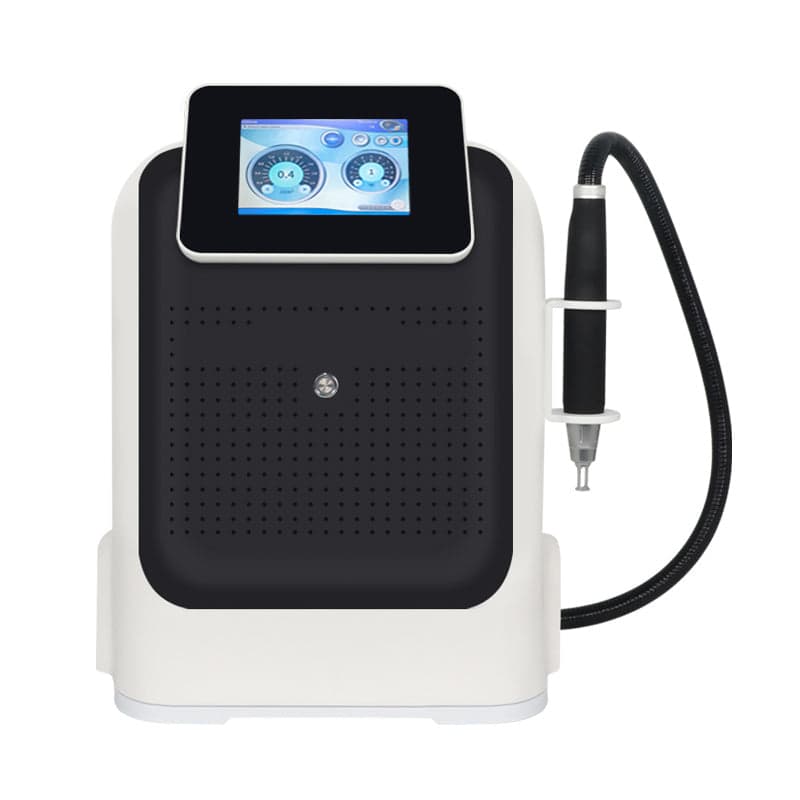
Picosecond laser machines remove tattoos and pigmentation faster and more safely than older nanosecond Q-switched lasers by shattering ink with a photoacoustic effect into finer, easier-to-clear particles. With 1064/532/755nm options and a fractional rejuvenation mode for texture, pores and acne scars, professional picosecond equipment offers fewer sessions and a better safety margin on darker skin. Lazzybeauty supplies CE/FDA-cleared picosecond laser machines with operator training and technical support.